Comparison with other optimizers
givp is not a replacement for derivative-based methods on smooth,
convex problems — scipy.optimize.minimize will be orders of magnitude
faster there. It targets the regime where:
- the objective is black-box (no gradients available);
- the landscape is multimodal (many local optima);
- variables can be mixed (continuous and integer);
- you want explicit budget control (max iterations or wall-clock).
The table below positions givp against widely used Python alternatives.
| Library / method | Black-box? | Multimodal? | Integers? | Budget control | Reproducible | Language | Notes |
|---|---|---|---|---|---|---|---|
scipy.optimize.minimize (BFGS, L-BFGS-B, ...) |
requires gradient | local only | no | iter only | yes | Python | great when smooth + unimodal |
scipy.optimize.differential_evolution |
yes | yes | continuous | maxiter | yes | Python | global, but no native integer support |
scipy.optimize.dual_annealing |
yes | yes | continuous | maxiter | yes | Python | strong on basins of attraction |
optuna (TPE/CMA) |
yes | yes | yes | n_trials, timeout | yes | Python | great for HP tuning, no SciPy-style API |
pyomo/gurobi |
structured | depends | yes (MIP) | yes | yes | Python | needs the model to be expressible analytically |
givp |
yes | yes | yes (mixed) | iter + time | yes (seed=) |
Python+Julia+Rust+C+++R | SciPy-style API, hybrid GRASP/ILS/VND/PR |
Apples-to-apples: Rastrigin-30D
import numpy as np
from scipy.optimize import differential_evolution, dual_annealing

from givp import GIVPConfig, givp


def rastrigin(x):
    n = len(x)
    return 10.0 * n + float(np.sum(x**2 - 10.0 * np.cos(2.0 * np.pi * x)))


bounds = [(-5.12, 5.12)] * 30

de = differential_evolution(rastrigin, bounds, seed=42, maxiter=100, tol=1e-8)
sa = dual_annealing(rastrigin, bounds, seed=42, maxiter=500)
gv = givp(
    rastrigin, bounds, seed=42,
    config=GIVPConfig(max_iterations=80, ils_iterations=10),
)

print(f"DE   -> fun={de.fun:.4f}  nfev={de.nfev}")
print(f"SA   -> fun={sa.fun:.4f}  nfev={sa.nfev}")
print(f"givp -> fun={gv.fun:.4f}  nfev={gv.nfev}")
Typical (machine-dependent) numbers on a laptop CPU:
Your mileage will vary — the point is that on a hand-crafted multimodal
landscape givp reaches a competitive minimum with comparable budget while
also accepting integer/mixed bounds out of the box.
When to pick what
- Smooth and unimodal —
scipy.optimize.minimize(L-BFGS-B). - Continuous, multimodal, no gradients —
scipy.dual_annealingorscipy.differential_evolution.givpcompetes here too. - Mixed integer/continuous, no gradients —
givpis purpose-built for this. SciPy's globals can't take integer indices natively. - Structured MIP —
pyomo+gurobi/cbc.givpis overkill. - ML hyper-parameter tuning —
optunafor the trial scheduler, butgivpworks (see examples).
Reproducibility
Every comparison above used a pinned seed. givp honours seed= end-to-end:
two runs with the same seed, bounds and objective return bit-identical
results. Other libraries vary in seeding semantics — read each one's docs.
Experimental protocol (30-seed sweep)
For publication-quality comparisons, use the same protocol in all language ports:
dims = 10n_runs = 30seed window = [0, 30)max_iter = 200time_limit = 30.0secondsalgorithms = GIVP-full DE PSO GA CMA-ES SA
Example command from the python/ directory:
# Step 1 — run experiment (≈ 30 min on a laptop)
python -m benchmarks.comparison \
  --dims 10 --n-runs 30 --max-iter 200 --time-limit 30.0 \
  --algorithms GIVP-full DE PSO GA CMA-ES SA \
    --traces --verbose \
    --output results/comparison_10d_30runs.json

# Step 2 — generate Markdown + LaTeX tables with Wilcoxon tests
python -m benchmarks.reporting \
    --input results/comparison_10d_30runs.json \
    --format both \
    --output-dir paper/tables/

# Step 3 — include in paper
#   paper/tables/comparison_10d_30runs_report.tex  → \input{tables/...}
#   paper/tables/comparison_10d_30runs_boxplot.png → \includegraphics{...}
Seeds: uses
[0, n_runs)by default — byte-identical results for any given seed. Use--seed-start Nto shift the window. Resume: add--resumeto continue a partial run (checkpointed after each function).
See python/benchmarks/README.md for the full option reference, including
higher-dimensional sweeps (--dims 30) and tuned-config runs
(--algorithms GIVP-tuned --tune-config best_config.json).
Generated benchmark artifacts
The docs-facing benchmark pages are now generated from the committed literature-comparison artifacts instead of being pasted manually into this page. Regenerate them from the repository root with:
The generated entry point lives at examples/benchmark-reports/index.md
and publishes per-language pages plus reusable SVG charts under
docs/examples/benchmark-reports/assets/.
Available generated pages
| Language | Generated page | Source artifact |
|---|---|---|
| Python | examples/benchmark-reports/python.md | Notebooks/Python/benchmark_literature_comparison_results.json |
| Julia | examples/benchmark-reports/julia.md | Notebooks/Julia/results_notebook_julia.json |
| Rust | examples/benchmark-reports/rust.md | Notebooks/Rust/benchmark_literature_comparison_rust_results.json |
| C++ | examples/benchmark-reports/cpp.md | Notebooks/Cpp/benchmark_literature_comparison_cpp_results.json |
| R | examples/benchmark-reports/r.md | Notebooks/R/benchmark_literature_comparison_r_results.json |
Example generated chart
The comparison page now consumes one of the generated SVG artifacts directly:
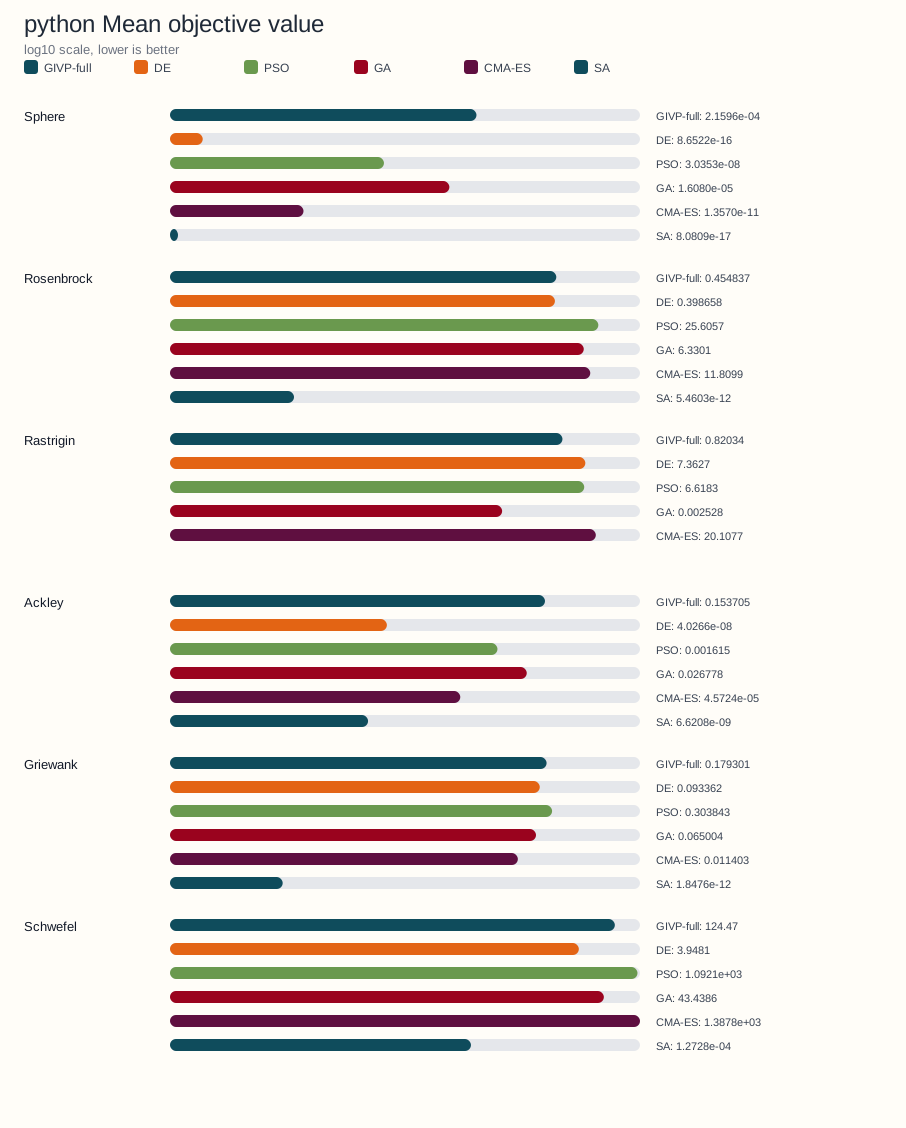
The per-language pages keep the detailed function tables, runtime ratios and source JSON links synchronized with the committed notebook artifacts.